Lucknow: The much-publicised Lucknow leg of the Cockroach Janata Party’s (CJP) nationwide agitation against alleged examination irregularities failed to generate the momentum its organisers had anticipated, with a modest turnout at ManyawarKanshiram Ji Green Eco Garden exposing the gap between the movement’s online popularity and its on-ground mobilization.
The youth-led satirical movement, which has gained significant visibility on social media through memes, videos and anti-paper leak campaigns, had announced a major protest demanding the resignation of Union Education Minister Dharmendra Pradhan over alleged irregularities in examinations such as NEET-UG, CBSE and CUET.

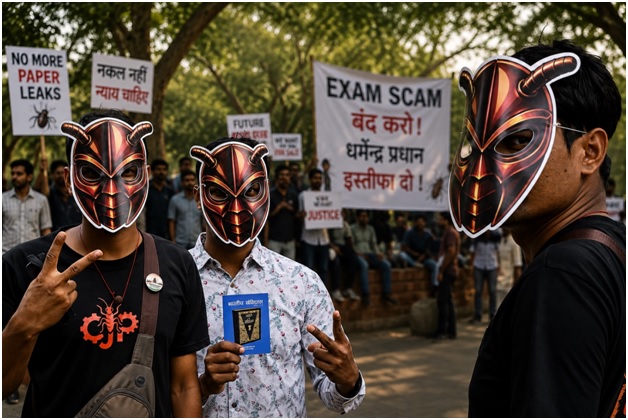
Despite days of online campaigning and repeated calls for students to gather in large numbers, the protest remained largely subdued. Small groups of demonstrators carrying placards and the party’s signature cockroach-themed symbols assembled at the designated protest venue in Alambagh under tight police supervision.
The event was marked by confusion from the outset over official permission. Earlier in the day, reports suggested that Lucknow Police had denied permission for a proposed rally, citing non-cooperation from organisers. However, later updates indicated that permission had been granted for a demonstration at Eco Garden, allowing the gathering to proceed under strict monitoring.
Heavy police deployment remained visible throughout the protest, ensuring that the event remained peaceful and within prescribed limits. Security personnel closely monitored the situation amid concerns that the demonstration could attract larger crowds or lead to disruptions.
One of the most discussed aspects of the protest was the absence of a significant student turnout. While organisers had projected a major mobilisation, attendance remained limited, with many observers noting that participants largely consisted of core supporters, volunteers and activists already associated with the movement.
Adding to the uncertainty were conflicting reports regarding the participation of CJP founder Abhijeet Dipke. While Dipke had earlier announced that he would join the Lucknow protest after similar demonstrations in Delhi and Pune, social media updates during the day suggested he might not attend. At the same time, other posts indicated that he was on his way to the venue and remained committed to the campaign. The mixed messaging further contributed to the lack of clarity surrounding the event.
The protest also witnessed signs of internal disagreement. Some students and teachers present at Eco Garden publicly distanced themselves from the Cockroach Janata Party, insisting that their concerns regarding recruitment examinations and educational reforms should remain independent of political branding.

Several participants were seen holding banners focused on recruitment issues and examination reforms rather than endorsing the broader political messaging associated with the CJP campaign. Slogans emphasizing transparency, accountability and fair examinations dominated the gathering.
Supporters of the movement argue that repeated paper leaks, postponed examinations and administrative failures have created widespread frustration among students across the country. Through its “Exam Manifesto,” the CJP has proposed a series of reforms, including compensation for candidates affected by cancelled examinations, stricter accountability mechanisms, age relaxation for impacted aspirants and improved examination security systems.
However, critics contend that the movement’s influence remains largely confined to social media. They point to the relatively low turnout in Lucknow and previous demonstrations as evidence that viral popularity does not automatically translate into a mass movement. Political opponents have also questioned whether the campaign is genuinely student-driven or increasingly shaped by broader political objectives.
The Lucknow event underscored a challenge faced by many contemporary activist movements: converting digital engagement into sustained grassroots participation. While the CJP has succeeded in keeping examination-related issues in the national conversation, Friday’s gathering suggested that public sympathy for those concerns may not necessarily translate into large-scale street protests.
Nevertheless, organisers remain determined to continue their campaign. The movement has announced plans for demonstrations in other cities, including Amritsar, Jaipur and Bengaluru, before culminating in a larger protest at Jantar Mantar in New Delhi later this month.
For now, the Lucknow protest serves as a reminder that while examination reforms remain an issue of concern for millions of students, building a nationwide movement around those demands requires more than social media traction. The modest turnout at Eco Garden has raised fresh questions about the Cockroach Janata Party’s ability to transform online visibility into tangible political influence.







 ---------------------------------------------------------------------------------------------------